5 Risks Healthcare Organizations Should Consider
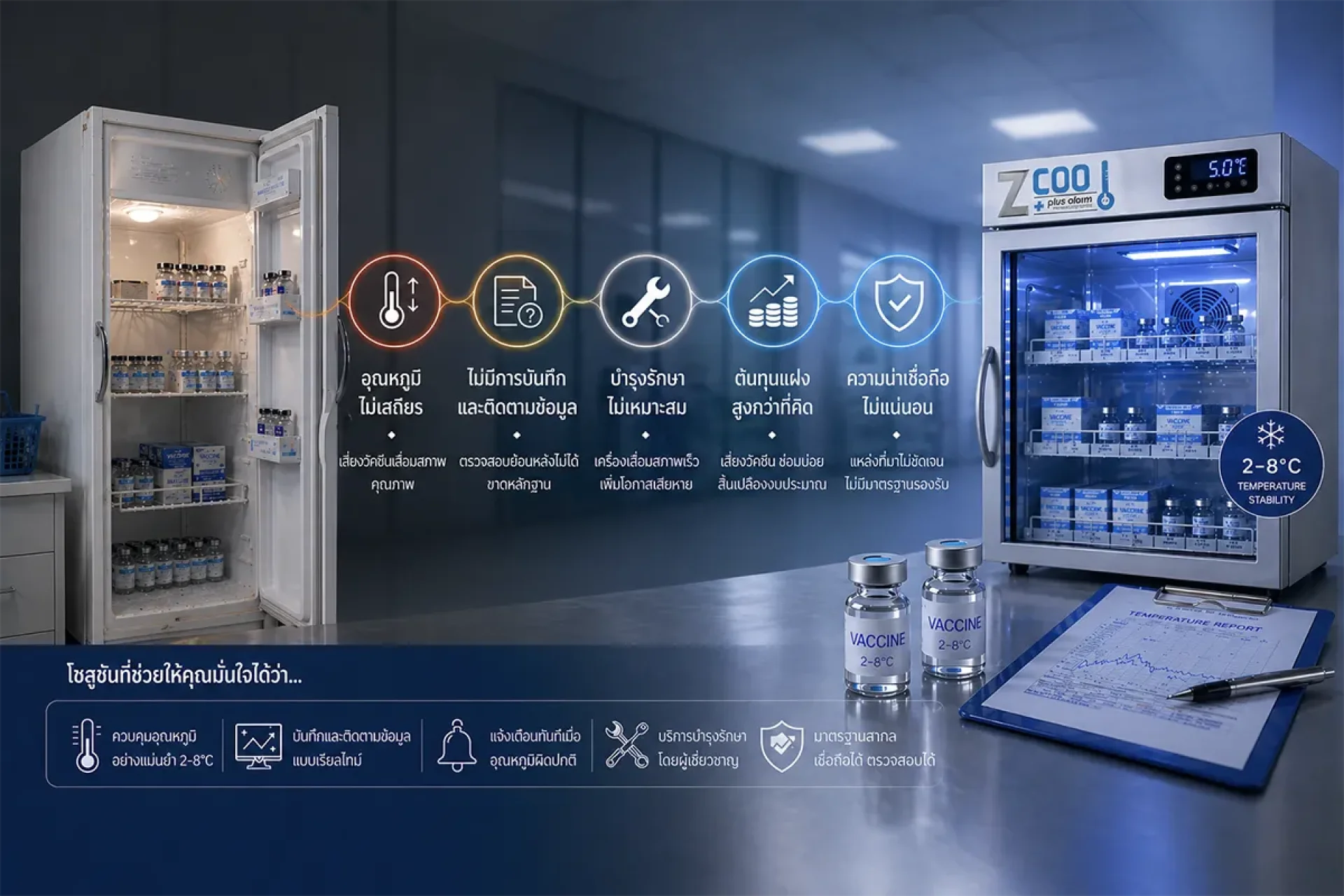
5 Risks Healthcare Organizations Should Consider
Before Choosing Vaccine Refrigerators Priced Significantly Below Market Value
Over the past several years, healthcare organizations have placed increasing importance on careful budget management. Comparing prices is both necessary and appropriate as part of the procurement process.
However, when it comes to vaccine and medical refrigerators, prices that are significantly lower than the market average may not simply reflect “lower costs” — they may also indicate that certain critical components, services, or safeguards are not included.
From more than 26 years of experience in Cold Chain systems, we have found that most problems do not occur on the day of installation. Instead, they often emerge after 1–3 years of operation, when small details that were overlooked during procurement begin to create significant operational impacts.
This article summarizes five key areas organizations should carefully evaluate before making a purchasing decision.
1️⃣ Risk of Temperature Instability
Most vaccines must be stored continuously within the 2–8°C range in accordance with international Cold Chain standards. Maintaining temperatures that are merely “close enough” is not sufficient without documented evidence of long-term stability.
Questions to ask before making a decision:
⏺︎ Is a complete Temperature Mapping report available?
⏺︎ Does the report clearly specify the number of measurement points, testing duration, and loading conditions?
⏺︎ Is there test data for low-voltage, power outage, or high ambient temperature conditions?
Some refrigerators may perform well under normal laboratory conditions but lack validated data under full-load or real-world high-temperature environments.
The risk is that vaccines may gradually lose potency without immediate detection.
2️⃣ Risk Related to Calibration and Traceability
Temperature monitoring systems must be properly calibrated and supported by certificates traceable to international standards.
Without a clearly documented calibration system:
⏺︎ Organizations may be unable to verify historical temperature accuracy
⏺︎ The facility may fail quality assessments such as QA or HA audits
⏺︎ Investigations into temperature excursions may become difficult or inconclusive
In some cases, lower-priced systems may not include calibration services or long-term data traceability capabilities.
3️⃣ Risk of Limited After-Sales Service and Emergency Response
A vaccine refrigerator is not equipment that can simply be “repaired after failure.”
Because the value of damaged vaccines can far exceed the cost of the refrigerator itself.
Key considerations include:
⏺︎ How many years of warranty coverage are provided?
⏺︎ Is there a Preventive Maintenance (PM) program?
⏺︎ Is emergency response time clearly defined?
⏺︎ Are local service teams or authorized service centers available?
In practice, the speed of technical support and problem resolution is a critical part of public health risk management.
4️⃣ Risk Related to Total Cost of Ownership
The purchase price is only the initial cost.
The true long-term cost includes:
⏺︎ Electricity consumption
⏺︎ Maintenance expenses
⏺︎ Annual calibration costs
⏺︎ Downtime costs during equipment failure
⏺︎ Vaccine losses resulting from temperature deviations
For example, if vaccines valued at 1–2 million THB are damaged due to a single temperature excursion, the resulting loss may far exceed the cost of the refrigerator itself.
In some situations, refrigerators priced significantly below market value may ultimately generate higher total ownership costs over their operational lifespan.
5️⃣ Risk Related to Supplier Continuity and Transparency
Vaccine storage is directly linked to public health safety.
Selecting a supplier should therefore be viewed as a long-term partnership rather than a one-time purchasing decision.
Questions organizations should ask:
⏺︎ How many years of experience does the supplier have in Cold Chain systems?
⏺︎ Are there long-term institutional reference clients?
⏺︎ Can technical documentation be independently verified?
⏺︎ Is it possible to request additional information or visit the manufacturing/assembly facility?
Transparency and consistency of standards form the foundation of long-term reliability and trust.
Conclusion
Selecting a vaccine refrigerator should not be based solely on comparing numbers in a quotation.
It is fundamentally about managing:
Vaccine integrity
Public safety
Organizational trust and credibility
From over 26 years of experience in Cold Chain systems, we have learned that careful decisions made at the beginning can significantly reduce operational problems in years 2–3 after installation.
Before making a decision, organizations should always ask:
Does a lower-than-market price truly reduce costs —
or simply shift the risks into the future?